sponsored links


Showing posts with label fact of global warming. Show all posts

Saturday, May 9, 2009

Why America Does Not Care About Global Warming

It is clear that concern in the United States over global warming is diminishing. In a Washington Whispers editorial, Paul Bedard quotes a Gallup Poll editor as saying Al Gore’s campaign to raise awareness of the “climate crisis” has failed. In one recent Pew Research Center survey, global warming rated at the bottom of a list of 20 domestic issues that Americans are concerned about.


Why is there so much apathy in the U.S. over something that threatens to transform the world by killing off thousands of species, flooding coastal areas, and making the world as much as 10 degrees F hotter? Do we just not care about the environment? Has the global warming message been oversold? Is the public experiencing ‘global warming fatigue’? Does the global warming problem seem so insurmountable to people that they just want to ignore it and hope that it goes away?


From my travels around the country and talking to people, the largest source of apathy is none of these. In my experience, people simply do not believe the ‘scientific consensus’ is correct. Most people do believe the Earth has warmed, but they think that warming has been largely natural. This was recently supported by a Rasmussen Reports poll which showed only 1/3 of American voters now believe global warming is caused by humans.


How can non-experts question the opinion of scientific experts? I believe it is because the public seems to have a better appreciation than the scientists do of a fundamental truth: There are some problems that science does not yet understand. There have been predictions of environmental doom before, and those have all failed. This has made people suspicious of spectacular scientific claims. As I have mentioned before, even Mark Twain over 100 years ago made fun of the predilection scientists have for making grand extrapolations and pronouncements:

There is something fascinating about science. One gets such wholesale returns of conjecture from such a trifling investment of fact.
-Mark Twain, Life on the Mississippi (1883)


The scientific community has brought this problem upon themselves by not following their own rules and procedures. Scientists have ‘cried wolf’ too many times, and some day that might end up hurting all of us when some unusual and dangerous scientific concern does arise. I think that people intuitively understand that spectacular scientific claims require spectacular evidence. Just saying something ‘might’ happen ‘if current trends continue’ does not impress the public. They have heard it all before.


The analogy I sometimes think about is our understanding of the human brain. What if there was a group of researchers who built a computer model of how the brain works, and they claimed that they could take some measurements of your brain and tell you what you would be thinking 24 hours from now. Would you believe them?


No, even though you are not an expert regarding the operation of the human mind, you probably would not believe them. From your daily experience you would suspect that those experts were probably overreaching, and claiming they knew more than they really did.


Of course, if the experts had performed such experiments before and succeeded, then you might be more inclined to believe them. But in the climate business, we have no previous forecast successes that are relevant to the theory of manmade global warming. We can’t even forecast natural climate variations, because we do not understand them. Simply forecasting long-term warming probably has a 50/50 chance of being correct just by accident, since it seems to be more common for warming or cooling to occur than for the temperature to remain constant, year after year, decade after decade.


And coming up with possible explanations for what has happened in the past (’hindcasts’) do not really count, either. It is too easy to happen upon the wrong explanation which can be made to fit the data, a technique scientists call (rather pejoratively) “curve-fitting”.


In weather forecasting, MANY forecasts are required before one can confidently determine, based upon the number of successes and failures, whether those forecasts had any real skill beyond what might be expected just based upon chance. Climate forecasting is nowhere near being able to demonstrate forecast skill to the level of confidence that is routinely discussed in weather forecasting.


So, for those of you in the environmental community who think the global warming message needs to be repackaged, or rephrased, or have a change in terminology …well…I think you are wasting your time. The people have gotten the message, loud and clear: Global warming is manmade, and it is only going to get worse.


The trouble is that the people simply don’t think you know what you are talking about. And if global warming is largely a natural process, cutting down on our greenhouse gas emissions is going to have no measurable effect on future global temperatures.


Now, if you think you might succeed through a different kind of deception of the public…well, that indeed might work.

Wednesday, February 11, 2009

Many North American Birds Moving Northward

A report just released by the Audubon Society shows that a significant number of bird species seen in North America during the first weeks of winter have moved dramatically northward over the span of 40 years.


Also, a number of grassland species are not following this northward trend and for these species disappearing habitat from warming is taking an enormous toll, and leaving them with nowhere to go.


One of our biggest movers, the Purple Finch.

How did they determine this?


Tens of thousands of citizen scientists take part in the Audubon's annual Christmas bird count and report their findings to the society. Based on an analysis of 305 bird species across North America, the results indicate an average northward movement of 35 miles. Sixty bird species out of the 305 actually moved in excess of 100 miles during the four decades!


Here are some of the more common birds with the greatest northward movement over the forty- year period.....


--Purple Finch (433 miles)
--Wild Turkey (408 miles). I can usually hear the turkeys over on the hill early in the mornings, but they are tough to spot.
--Ring-Billed Gull (356 miles)
--Pine Siskin (288 miles). There was a front-page report in our local central Pennsylvania paper a couple weeks ago about the appearance of this bird in our region.
--Boreal Chickadee (279 miles)
--House Finch (270 miles). I can say we have plenty of these around my neighborhood!


According to the Audubon Society, the results of this study is evidence that global warming is having serious impact on natural systems.

Wednesday, February 4, 2009

200 New Species Found. Global Warming To Blame?

Are you still worried about all the talk of animals going extinct? Don’t be. The world still revolves around the sun, there are births, there are deaths, and species go extinct. And new ones are found. Much to the dismay of the global warming crowd, for every extinction, there is a new birth. Take a look at these.

frog-1 frog2 sali

Ten newfound species of amphibians — including a frog with spiky skin and three varieties of frogs with transparent skin — have been discovered in the mountains of Colombia.

The new species were found on a recent expedition led by herpetologists from Conservation International and ornithologists from the Ecotrópico Foundation in Colombia’s mountainous Tacarcuna area of the Darien, near the border with Panama.

Over a period of three weeks, the scientists identified approximately 60 species of amphibians, 20 reptiles and almost 120 species of birds, many of them apparently found nowhere else in the world.

Well I’ll be danged. In three weeks they found 200 species of “new” animals. Now how does that square with all the gloom and doom of the Global Warming Cult saying that “______” is going extinct this week? Just imagine what else is out there we don’t know about.

Colombia holds one of the most diverse amphibian communities in the world, with 754 species currently recorded.

Amphibians are considered important indicators of ecosystem health because their porous, absorbent skin makes them highly susceptible to pollution and climate change.

Other surprising findings included the presence of Central American species recorded for the first time in the northern area of South America, including a salamander (Bolitoglossa taylori), a rain frog (Pristimantis pirrensis), a small lizard (Ptychoglossus myersi) and a snake not yet identified.

Many frog and amphibian species around the world have suffered die-offs in recent years because of a lethal fungus that infects their skin and spreads quickly between geographic areas.

“Without a doubt this region is a true Noah’s Ark,” said Jose Vicente Rodriguez-Mahecha, scientific director of Conservation International-Colombia. “The high number of new amphibian species found is a sign of hope, even with the serious threat of extinction that this animal group faces in many other regions of the country and the world.”

The expedition also recorded the presence of large mammals such as Baird’s tapir (Tapirus bairdii), whose closest relatives include horses and rhinoceroses, and which are listed on the IUCN Red List as endangered in Colombia.

The biologists also found four species of monkeys, including Geoffroy’s spider monkey (Ateles geoffroyi), Geoffroy’s tamarin or red crested bare-faced tamarin (Saguinus geoffroyi), white-throated capuchin or Gorgona white-fronted capuchin (Cebus capucinus), and the mantled howler monkey (Alouatta palliata). Populations of the white-lipped peccary (Tayassu pecari), which resembles a furry pig, also were found.

Yep, The cult would have you think the world is collapsing around us. But as you can see, this world is cyclical. That goes for the climate as well as the inhabitants. The arrogance of some people to think we can change that is just beyond belief. We, as a species, are newcomers to this planet, and would do well to remember that fact and quit trying to alter the course of life.

Source

Tuesday, February 3, 2009

Four Scary Surprises of Global Warming


Every once in a while I'll get an email or comment that can be roughly paraphrased as "I'm not actually that big a fan of cold weather...so why should I be worried about increasing CO2 emissions?"


Well, for you, I've put together a list of four somewhat surprising (and quite unsettling) things that that scientists have determined are occurring because of rising CO2 levels.


  1. Global Depression
    Depending on who you ask, the necessary changes the world will have to make as a result of global warming (everything from building higher sea walls to relocating entire cities) will cost up to 20% of the world's GDP. So, yeah, you think it's bad when we have a financial fall-out from a little housing bubble...imagine having 20% of the world's economy sucked into a hole the size of the Larsen Ice Shelf.
  2. Global Fish Kill
    One of the oft-overlooked, but possibly most devastating consequences of global warming is the acidification of the oceans. Oceans suck up huge amounts of CO2. And as the concentration of CO2 in the atmosphere increases, so does the amount absorbed by the world's oceans. Unfortunately, when the CO2 enters the water, it creates carbonic acid. So, over the last hundred years or so, the acidity of the ocean has increased so much that it is literally eroding the shells of mollusks. Unfortunately, these mollusks are the base of many marine ecosystems, important to everything from salmon to sperm whales. The possibilities of an oceanic mass-extinction are on the rise.
  3. Global Hunger
    There is a massive amount of infrastructure in place to create the world's food. And that infrastructure depends on a fairly stable climate. We expect the rain to fall where and when it falls, we expect the thaw to come where and when it comes. But global warming does more than change the temperature, it changes the climate. Projections show more rain in dry areas and less rain in wet areas, the result of which could be the need to completely re-create much of our farming infrastructure. In th meantime, while that infrastructure is being created, we should expect that a lot of people will be very hungry.
  4. Feedback Loops
    A positive feedback loop is not something one likes to see in nature. For example, if melting snow creates more heat-absorbing land which creates more melting snow which creates more heat absorbing land, we have a positive feedback loop that is likely to exponentially increase its effect on global climate. These feedback loops are everywhere in climate models. From decreasing albedo (the example above) to increased wild fires puffing cities-worth of CO2 into the atmosphere to the Canadian boreal forests dying due to climate change and thus releasing their 27 years-worth of stored carbon into the atmosphere.


So yes...this time of year, I appreciate a nice warm day as much as the next guy. But those who get excited about global warming just don't know what they're talking about. And my thanks go to the scientists who work tirelessly to determine what effect climate change will have on us all, and what we need to do to deal with it.

Saturday, January 24, 2009

Hybrid Cars and Global Warming: the Facts

Global Warming is a considerable increase in the climate temperature of the earth in a short period of time due to human activity. Global warming could result in the arctic ice thinning which would increase the sea level, as well as other extreme weather such as floods, hurricanes etc. Climate change is a major problem in the twenty first century, and a lot has to be done in order to turn things around for future generations. Car producers have been forced to develop new technologies to reduce the level of gas emissions that go into the air.


Vehicles on the road are responsible for nearly one quarter of yearly emission of carbon dioxide the principal global warming gas in the United States. With the exception of three other countries, the United States transportation sector emits more carbon dioxide than all other countries combined.


What Hybrid Cars can do for global warming


Hybrids innovative technology is an alternative energy solution which helps to reduce the risk of global warming.It is clear that excessive gas consumption causes problems to the environment. A gallon of gasoline weighs approximately six pounds, and when burned the carbon inside the gas combines with oxygen from the air to produce nearly twenty pounds of carbon dioxide. When a hybrid car is used instead of a car that devours gas to the extreme, the earth can be spared a lot of unnecessary greenhouse gas.


Hybrid cars reduce fuel emissions because the hybrid engine uses the battery and not gasoline when accelerating. Also hybrid motors shut off when the car is stopped and run off their electricity. Hybrid cars use an electric motor which assists the cars gasoline engine. The help of the motor lets the gasoline engine work less, which improves fuel economy and lowers emissions of pollution going into the air. Hybrid cars reduce smog by ninety percent and use far less gas than conventional cars do.


Hybrid cars can clearly contribute to the prevention of global warming because they reduce gas consumption and limit gas emissions. These ways reduce carbon dioxide in the atmosphere which holds back the effects of global warming. While they may not be the complete answer to the problems that the world faces in terms of the climate changes and global warming, they are more than a small contribution, and if the majority of people chose them as an option, it would make a big difference to the problems we are facing.

Sunday, January 18, 2009

Global Warming Is a Cause of Extreme Weather


It's almost a point of pride with climatologists. Whenever someplace is hit with a heat wave, drought, killer storm or other extreme weather, scientists trip over themselves to absolve global warming. No particular weather event, goes the mantra, can be blamed on something so general. Extreme weather occurred before humans began loading up the atmosphere with heat-trapping greenhouse gases such as carbon dioxide. So this storm or that heat wave could be the result of the same natural forces that prevailed 100 years ago—random movements of air masses, unlucky confluences of high- and low-pressure systems—rather than global warming.


This pretense has worn thin. The frequency of downpours and heat waves, as well as the power of hurricanes, has increased so dramatically that "100-year storms" are striking some areas once every 15 years, and other once rare events keep returning like a bad penny. As a result, some climatologists now say global warming is to blame. Rising temperatures boost the probability of extreme weather, says Tom Karl, director of the National Climatic Data Center and lead author of a new report from the Bush administration's Climate Change Science Program; that can "lead to the type of events we are seeing in the Midwest." There, three weeks of downpours have caused rivers to treat their banks as no more than mild suggestions. Think of it this way: if once we experienced one Noachian downpour every 20 years, and now we suffer five, four are likely man-made.


It's been easier to connect global warming to rising temperatures than to extreme weather events—and even the former hasn't been easy. Only in this decade have "attribution" studies managed to finger greenhouse gases as the chief cause of the rising mercury, rather than a hotter sun or cyclical changes. (The last two produce a different pattern of climate change than man-made warming does.) Now the same "whatdunit?" techniques are being applied to droughts, downpours, heat waves and powerful hurricanes. "We can look at climate-model simulations and likely attribute [specific extreme weather] to human activity," says Gerry Meehl of the National Center for Atmospheric Research.


The Midwest, for instance, suffered three weeks of intense rain in May and June, with more than five inches falling on some days. That brought a reprise of the area's 1993 flooding, which was thought to be a once-in-500-years event. The proximate cause was the western part of the jet stream dipping toward the Gulf of Mexico, then rising toward Iowa—funneling moisture from the gulf to the Midwest, says meteorologist Bill Gallus of (the very soggy) Iowa State University. The puzzle, he says, is why the trough kept reforming in the west, creating a rain-carrying conveyor belt that, like a nightmarish version of a Charlie Chaplin movie, wouldn't turn off. One clue is that global warming has caused the jet stream to shift north. That has brought, and will continue to bring, more tropical storms to the nation's north, and may push around the jet stream in other ways as well.


Global warming has left its clearest fingerprint on heat waves. Since the record scorcher of 1998, the average annual temperatures in the United States in six of the past 10 years have been among the hottest 10 percent on record. Climatologists predict that days so hot they now arrive only once every 20 years will, by midcentury, hit the continental United States once every three years. Scientists also discern a greenhouse fingerprint in downpours, which in the continental United States have increased 20 percent over the past century. In a warmer world, air holds more water vapor, so when cloud conditions are right for that vapor to form droplets, more precipitation falls. Man-made climate change is also causing more droughts on top of those that occur naturally: attribution studies trace droughts such as that gripping the Southwest to higher sea-surface temperatures, especially in the Pacific. Those can fluctuate naturally, as they did when they caused the severe droughts of the 1930s and 1950s. But they are also rising due to global warming, causing a complicated cascade of changes in air circulation that shuts down rainfall.


Hurricanes have become more powerful due to global warming. For every rise of 1 degree Celsius (most of it man-made) in surface temperatures in the tropical Atlantic, rainfall from a tropical storm increases 6 to 18 percent and wind speeds of the strongest hurricanes increase by up to 8 percent. As the new report acknowledged, "the strongest storms are becoming even stronger." Atmospheric conditions that bring severe thunderstorms (with hail two inches across and wind gusts of at least 70 miles an hour) and tornadoes with a force of F2 or greater have been on the rise since the 1970s, occurring about 8 percent more often every decade. Get used to it, and don't blame Mother Nature.

Inauguration day and climate change politics

Inauguration day 2005: 35 °F Mostly cloudy with some sunny breaks.
Northwest wind 14 mph. Around 1″ of snow lay on the ground.
More inauguration day weather history is available here

There is much speculation about the weather on Tuesday, January 20th, which is the inauguration day of president Obama. Particularly it is being conjectured widely on the blogosphere that a colder than normal day might have some chilling effect on climate change thinking in Washington. After all, it is not unlike politicians to grasp onto ancillary topics and use them as the focal point for forming opinions.

For example, as reported here, The last time Dr. Roy Spencer testified before Congress, committee chair Barbara Boxer appeared more interested in discussing Rush Limbaugh than she did in discussing science. That is not necessarily a sensible way to weigh trillion dollar policy decisions.

Here is another example. When Dr. James Hansen testified before Congress in June, 1988, on the topic of global warming, Senator Timothy Wirth took several deliberate steps to make sure that the room was oppressively hot. This excerpt below is from a PBS Frontline interview:

TIMOTHY WIRTH: We called the Weather Bureau and found out what historically was the hottest day of the summer. Well, it was June 6th or June 9th or whatever it was. So we scheduled the hearing that day, and bingo, it was the hottest day on record in Washington, or close to it.DEBORAH AMOS: [on camera] Did you also alter the temperature in the hearing room that day? TIMOTHY WIRTH: What we did is that we went in the night before and opened all the windows, I will admit, right, so that the air conditioning wasn’t working inside the room. And so when the- when the hearing occurred, there was not only bliss, which is television cameras and double figures, but it was really hot.

That is going to be a lot tougher now, after two more decades of unprecedented global warming.

As of Saturday morning, NCEP is forecasting severe cold along the East Coast for the end of the month, and well below normal temperatures for the inauguration of president Obama. Perhaps the chill will freeze out some the early political rhetoric in Washington? Some prominent members of Congress now claim that they can legislate the climate, which requires that they also are able to control volcanoes, ocean circulation patterns, and solar activity.

Here is the NCEP CONUS temperature forecast for now to election day:


Click for a larger image


One wonders though, it the weather patterns were shifted west to east in the anomaly graph below, and we had a warmer than normal inauguration day in Washington, would it provide lawmakers with a personal confirmation bias much like that day in June, 1988?


Thanks to wattsupwiththat

Friday, January 16, 2009

Predicting New Global Temperature Record within Two Years

The Goddard Institute for Space Studies (GISS), which is under the authority of NASA has released their December 2008 temperature data and also the full 2008 annual data.

First, here is their December global anomaly map....


I did not see any of the specific numbers for the month, but I will continue to look..


The year 2008.


The base period from 1951-1980 was used to determine the global temperature anomalies.


--2008 was the coolest year since 2000, which is supported by other methods. (+0.44).


--2008 was the 9th warmest year since records were kept back to 1880. When considering the
margin of uncertainty, GISS is confident that 2008 was somewhere between the 7th and 10th warmest year on record.


--The ten warmest years all occurred from 1997-2008.


GISS states that comparing the 2008 chart below left with the mean 2001-2007 anomalies clearly shows why 2008 was the coolest since 2000. The main differences between the two charts is in the Pacific. Note: the cooling in the Pacific during 2008 and also over North America.


GISS also responds to questions about their prediction from last year which stated that a new global temperature record was likely within the next 2-3 years (now, the next 1-2 years).


According to GISS, there are several factors to consider when making this prediction......


1. El Nino Southern Oscillation (ENSO). History says that a prolonged La Nina is unlikely for 2009/2010 despite the trends over the past few months. The subsurface of the Pacific in their opinion appears recharged for the next El Nino and there is a good chance for an El Nino in 2009 or 2010. Note; There is usually a 3-6 month lag in global temperature response to a change in ENSo conditions.


2. Solar Irradiance. Most solar physicists expect the irradiance to begin to pick up in the next several months after a longer than normal period of low solar output. Even if the irradiance does pick up, the 1-2 year lag in any surface temperature response to the cycle means that solar irradiance will continue to provide a negative anomaly for the next 2-3 years.


3. Volcanic aerosols.


4. Greenhouse gases (GHG's). The latest GHG forcing trend translates into a mean warming rate of ~0.15 Celsius per decade.


Updated prediction from GISS.......It still seems likely that a new global temperature record will be set within the next 1-2 years, despite the moderate negative effect of the reduced solar irradiance.


Thanks to global-warming.accuweather

Tuesday, January 13, 2009

Greenland Glaciers may be Stabilizing after Rapid Retreat

Greenland Glaciers.


So far this century, the glaciers of Greenland have been shrinking at a rapid pace, but according to a new study from Durham University in England this rapid decrease may stall out despite atmospheric warming, thus diminishing Greenland's contribution to rising sea levels due to global warming.


"Our modeling suggests that these very high rates of glacier retreat can’t be maintained for very long," said Andreas Vieli, a co-author of the paper, according to the Bloomberg.com article.


Studies at one particular glacier (Helheim) in Greenland indicated that the main driver of the melting was a break at the glacier's snout in the sea that had a domino effect inland. But, the researchers found that the glaciers stabilize after an initial rapid retreat.


The Helheim glacier retreated 7 kilometers between 2003 and 2005, but has since advanced 4 kilometers.


Images showing the retreat of the Helheim Glacier from 2001-2005.


This latest study will help scientists to tune existing computer models for ice sheets to predict future melting, Vieli said.


thanks global-warming.accuweather

Global warming may leave half of world's population without food by 2100

Washington, Jan 9 : Global warming is likely to give rise to severe food shortage by the end of this century, according to researchers, who claim that the rapidly warming climate may alter crop yields in the tropics and subtropics.

And the worst hit will be the regions where the poorest people already live that is the tropics and subtropics.

According to the researchers, there is greater than a 90 percent probability that by 2100 the lowest growing-season temperatures in the tropics and subtropics will be higher than any temperatures recorded there to date.

"The stresses on global food production from temperature alone are going to be huge, and that doesn't take into account water supplies stressed by the higher temperatures," said David Battisti, a University of Washington atmospheric sciences professor.

"This is a compelling reason for us to invest in adaptation, because it is clear that this is the direction we are going in terms of temperature and it will take decades to develop new food crop varieties that can better withstand a warmer climate.

"We are taking the worst of what we've seen historically and saying that in the future it is going to be a lot worse unless there is some kind of adaptation," he added.

During the study, the researchers combined direct observations with 23 global climate models that contributed to Nobel prize-winning research in 2007 and used the data as a filter to view historic instances of severe food insecurity,

They concluded that such instances are likely to become more commonplace.

Those include severe episodes in France in 2003 and the Ukraine in 1972. In the case of the Ukraine, a near-record heat wave reduced wheat yields and contributed to disruptions in the global cereal market that lasted two years.

The serious climate issues will not be limited to the tropics, the scientists conclude.

As an example, they cite record temperatures that struck Western Europe in June, July and August of 2003, killing an estimated 52,000 people.

The summer-long heat wave in France and Italy cut wheat yields and fodder production by one-third. In France alone, temperatures were nearly 6.5 degrees Fahrenheit above the long-term mean, and the scientists say such temperatures could be normal for France by 2100.

In the tropics, the higher temperatures can be expected to cut yields of the primary food crops, maize and rice, by 20 to 40 percent, the researchers said. But rising temperatures also are likely to play havoc with soil moisture, cutting yields even further.

"We have to be rethinking agriculture systems as a whole, not only thinking about new varieties but also recognizing that many people will just move out of agriculture, and even move from the lands where they live now," Naylor said.

Temperature increases from climate change are expected to be less in equatorial regions than at higher latitudes, but because average temperatures in the tropics today are much higher than at midlatitudes, rising temperature will have a greater impact on crop yields in the tropics.

The research appears in journal Science.

Global warming will be a killer for agriculture, UW scientists say

Forget ice melting and sea-level rise. Global warming's most pressing threat may be heat that wilts crops across much of the globe, says a UW scientist.

When searing heat waves blasted Western Europe in 2003, more than 50,000 people perished and harvests of corn, wheat and fruit fell by up to a third.

Imagine those temperatures being the norm over much of the world, and you'll have an idea of what the future is likely to hold for agriculture — and humanity, says a new report from scientists at the University of Washington and Stanford University.

"I'm not worried about Greenland sliding into the sea. I'm not worried about sea levels going up," said UW atmospheric-sciences professor David Battisti. Those changes will take several hundred years to unfold, he said, but the effects on agriculture will begin showing up within the next several decades.

"This is probably the most compelling reason why we need to deal with global warming."

If the buildup of greenhouse-gas emissions isn't halted or slowed, the odds are higher than 90 percent that average growing-season temperatures will be higher than in recorded history across a big swath of the planet by the end of the century, says the analysis published today in the journal Science. The hardest-hit areas will be the tropics and subtropics, which encompass about half the world's population and include Africa, the southern United States, and much of India, China and South America.

"We are headed for a completely out-of-bounds situation for growing food crops in the future," said report co-author Rosamond Naylor, director of Stanford's Program on Food Security and the Environment.

There is time to adapt to the rising temperatures through development of heat-resistant crops, the scientists say.

High temperatures cause plants like rice, corn and wheat to grow faster but reduce plant fertility and grain production. With average growing-season temperatures expected to rise more than 6 degrees F in many places, crop yields will fall 20 to 40 percent, the report estimates. The effects will be aggravated by increased evaporation and loss of soil moisture.

Even in the United States, where warming caused by greenhouse-gas emissions is projected to increase some crop yields through the middle of this century, harvests will most likely fall by 2100 as the heat intensifies.

But worldwide, the impacts will be felt most keenly by subsistence farmers and the poor, Battisti pointed out.

"You're talking about hundreds of millions of additional people looking for food because they won't be able to find it where they find it now."

France and Italy were able to turn to other nations to fill their food gaps in 2003, but a 1972 drought in the former Soviet Union showed how easily worldwide grain supplies can be disrupted, the report says. After the Soviets secretly began buying vast amounts of wheat, global prices more than tripled.

In a warmer future, there will be fewer places to turn for help when the cupboards are bare, Battisti said. "In a sense, there will be no place to hide from this."

The scientists reached their conclusions by combining climate data with projections from 23 global climate models used by the Intergovernment Panel on Climate Change, winner of the 2007 Nobel Peace Prize.

Michael Glantz, a political scientist who studies the social impacts of climate and climate change, said the study raises some good points, but that the developing world faces so many immediate problems it's difficult to worry about what will happen in five decades or more.

"When I think about 2100 and climate-change impact on food security, I just glaze over," said Glantz, who directs the Consortium for Capacity Building at the University of Colorado, Boulder.

But Cary Fowler, director of the Rome-based Global Crop Diversity Trust, says the report is a wake-up call for the need to develop new heat-resistant crop strains.

"This research shows we're about to enter a whole new game," said Fowler, whose group receives funding from the Bill & Melinda Gates Foundation and operates the "doomsday" seed vault on the remote Norwegian island of Spitsbergen.

It can take two decades or more to breed a new crop strain, but investments in agricultural research have been stagnant for the past several decades, Naylor pointed out.

The Gates Foundation is helping fund an effort in Africa to develop hardier crop strains. That work hasn't focused specifically on heat tolerance, said Gary Toenniessen, of the Rockefeller Foundation, a partner in the project. But it is helping developing agricultural-research capacity where it will be needed most in the future.

Spurred partly by Battisti's work, the Global Crop Diversity Trust has launched a program to screen existing seed collections for traits like heat and drought resistance, Fowler said. It's also developing a computerized database to share the information.

"Plants can be adapted to a range of temperatures," Fowler said. "This really is a problem that we can solve."

Scientists seek clues in historic global warming

Climate experts today began a major conference in Wellington canvassing evidence of climate change before humans .

The conference at Te Papa, organised by GNS Science, is probing evidence of greenhouse effects in the climate of the Paleogene period, 65 to 35 million years ago.

This is thought to be the most recent time the Earth experienced global warming on a scale similar to what is now being projected as a result of human activity.

On Wednesday, leading scientists will stage a one-day symposium to showcase the role that research into the ancient greenhouse world can play in advancing understanding of modern climate change.

Speakers will explore the role of greenhouse gases in driving Paleogene episodes of extreme global warming, the effects that warming had on biological systems, how natural feedback systems modulate climate and atmospheric greenhouse gas levels and the effectiveness of climate models in simulating greenhouse climate states.

Conference organiser Chris Hollis said there was growing evidence that temperatures in high latitude places like New Zealand have been far higher than previously thought.

In a paper on global temperature over the past 100 million years, Professor Peter Barrett, of Victoria University, said the "greenhouse world" was 6degC to 7degC warmer than today with only small ice sheets in the interior of Antarctica.

Antarctic ice core records from relatively recent times showed a close association between atmospheric carbon dioxide levels and temperature over the past 800,000 years.

"It seems that from a geological perspective, without concerted intervention now, there is a credible risk of Earth's climate, by the end of the century, reverting to greenhouse world temperature, but with `residual' polar ice sheets," he said.

What global warming?

U.S., Europe feel big chill But climate change shows no end in sight, scientists say

LONDON — Where has global warming gone when we need it most?

As cities from Chicago to London deal with an unusually bitter winter, weather records show that 2008 was one of the cooler years in the last decade. And the early months of 2009 are shaping up as "numbing" in the United States, according to the Farmer's Almanac, that nearly 200-year-old source of traditional weather lore.

Britain this year has had its coldest start to winter in 30 years, with temperatures 5 degrees below average, but "this would have felt like a warm year as recently as the 1980s, and an exceptionally warm year in Victorian times," said Myles Allen, an atmospheric physicist at the University of Oxford.

In most parts of the world, "what we regard as normal weather is the average weather over the past 10 years," he said. "We forget what it was like before then," even if someone occasionally drags out old photos of houses roof-high in snowdrifts or tales of slogging miles to school in near-impassible conditions.

Britain's recent deep freeze —its coldest spell since 1996—is due to stalled weather patterns that have funneled in frigid air from Siberia and from continental Europe, which is also shivering after years of unusually mild winters, according to the Hadley Center, the United Kingdom's leading weather service.

Stalled or unusual weather patterns also have contributed to remarkable snow and cold in Chicago and across much of the United States this winter. So far, this winter has been the 22nd coldest in 139 years of record-keeping in Chicago, and the fourth-snowiest in 124 years of records, according to Tom Skilling, chief meteorologist at WGN-TV. On Thursday, Chicago could see its first subzero high temperature in nearly 13 years.

"Just because certain areas cool down in the midst of an overall warming trend doesn't mean warming isn't going on," Skilling said. But the intensity of the cold and snow over the past two winters is raising some questions about how well scientists understand the interaction of an array of weather-changing forces, from sunspots to volcanic activity.

For instance, one reason the last two winters have been chillier than normal, climate scientists say, is a cyclical change in Pacific Ocean currents known as La Nina. In La Nina years, cold ocean currents rise to the surface near the equator, often causing cooler winters in northern regions like the United States. An opposite warming effect occurs in El Nino years.

Meteorologists say La Nina phase in the Pacific is now ending, and some predict that by 2010 the world should again be seeing some of the warmest years on record—warm enough that the Hadley Center is warning that poor residents of Britain may need help paying air-conditioning bills this summer.

But other meteorologists see evidence of an unusual second La Nina on the rise in the Pacific, which could extend the current stretch of colder-than-average winters.

"It's a very complex puzzle, this whole climate thing," Skilling said.

Snowfall in Chicago in recent years still isn't anything approaching the snowy winters of the 1970s, when the Chicago average was 54 inches, Skilling said. But he said graphs his research department has drawn up suggest "we're cycling back into an era of a little more snow."

Whether that is a simply a temporary break from a long-term rise in planetary temperatures or a new, not-well-understood winter trend isn't entirely clear. But "the fact that 2009, like 2008, will not break records does not mean that global warming has gone away," warned Phil Jones, director of climate research at the University of East Anglia in England.

In fact, "when you step back and look at the bigger picture, the overwhelming evidence is that temperature is increasing around the world," said John Hammonds, a meteorologist with the Hadley Center.

Sunday, January 11, 2009

Polar Sea Ice Changes are Having a Net Cooling Effect on the Climate


A guest post by Steven Goddard

One of the most widely discussed climate feedbacks is the albedo effect of polar sea ice loss. Ice has a relatively high albedo (reflectance) so a reduction in polar ice area has the effect of causing more shortwave radiation (sunlight) to be absorbed by the oceans, warming the water. Likewise, an increase in polar sea ice area causes more sunlight to be reflected, decreasing the warming of the ocean. The earths radiative balance is shown in the image below. It is believed that about 30% of the sunlight reaching the earth’s atmosphere is directly reflected - 20% by clouds, 6% by other components of the atmosphere, and 4% by the earth’s surface.

Radiation & Climate Slide
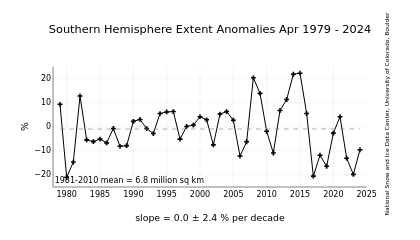
We all have heard many times that summer sea ice minimums have declined in the northern hemisphere over the last 30 years. As mentioned above, this causes more sunlight to reach the dark ocean water, and results in a warming of the water. What is not so widely discussed is that southern hemisphere sea ice has been increasing, causing a net cooling effect. This article explains why the cooling effect of excess Antarctic ice is significantly greater than the warming effect of missing Arctic ice.
Over the last 30 years Antarctic sea ice has been steadily increasing, as shown below.

http://nsidc.org/data/seaice_index/images/s_plot.png

December is the month when the Antarctic sun is highest in the sky, and when the most sunlight reaches the surface. Thus an excess of ice in December has the maximum impact on the southern hemisphere’s radiative balance. In the Antarctic, the most important months are mid-October through mid-February, because those are months when the sun is closest to the zenith. The rest of the year there is almost no shortwave radiation to reflect, so the excess ice has little effect on the shortwave radiative (SW) balance.

This has been discussed in detail by Roger Pielke Sr. and others in several papers.
http://www.climatesci.org/publications/pdf/R-222.pdf
http://www.climatesci.org/publications/pdf/R-256.pdf

So how does this work? Below are the details of this article’s thesis.

1. As mentioned above, the Antarctic ice excess occurs near the December solstice when the sun is highest above the horizon. By contrast, the Arctic ice deficiency appears near the equinox - when the sun is low above the horizon. Note in the graph below, that Arctic ice reaches it’s minimum in mid-September - just when the sun is setting for the winter at the North Pole. While the September, 2008 ice minimum maps were dramatic, what they did not show is that there was little sunlight reaching the water that time of year. The deviation from normal did not begin in earnest until mid-August, so there were only a couple of weeks where the northern hemisphere SW radiative balance was significantly impacted. Thus the water in most of the ice-deficient areas did not warm significantly, allowing for the fast freeze-up we saw during the autumn.
The 2008 peak Arctic ice anomaly occurred near the equinox, when it had the minimum heating effect on the ocean.
http://www.ijis.iarc.uaf.edu/seaice/extent/AMSRE_Sea_Ice_Extent.png
By contrast, the peak Antarctic ice anomaly occurred at the December solstice, when it had a maximum cooling effect, as shown below.
http://nsidc.org/data/seaice_index/images/daily_images/S_timeseries.png
2. The next factor to consider is the latitude of the ice, which has a strong effect on the amount of solar insolation received. Arctic sea ice is closer to the pole than Antarctic sea ice. This is because of the geography of the two regions, and can be seen in the NSIDC images below.

http://nsidc.org/data/seaice_index/images/daily_images/N_daily_extent.png
http://nsidc.org/data/seaice_index/images/daily_images/S_daily_extent.png

Antarctic sea ice forms at latitudes of about 55-75 degrees, whereas most Arctic ice forms closer to the pole at latitudes of 70-90 degrees. Because Antarctic ice is closer to the tropics than Arctic ice, and the sun there reaches a higher angle above the horizon, Antarctic sea ice receives significantly more solar radiation in summer than Arctic sea ice does in its’ summer. Thus the presence or absence of Antarctic ice has a larger impact on the SW radiative balance than does the presence or absence of Arctic ice.

At a latitude of -65 degrees, the sun is about 40 degrees below the zenith on the day of the solstice. Compare that to early September negative anomaly peak in the Arctic at a latitude of 80 degrees, when the sun is more than 70 degrees below the zenith. The amount of solar radiation hitting the ice surface at those maxima is approximately 2.2 times greater in the the Antarctic than it is in the Arctic = cos(70) / cos(40) .

The point being again, that due to the latitude and date, areas of excess Antarctic ice reflect a lot of SW radiation back out into space, whereas deficient Arctic ice areas allow a much smaller quantity of SW radiation to reach the dark surface of water. Furthermore, in September the angle of incidence of the sun above the water is below the critical angle, so little sunlight penetrates the surface, further compounding the effect. Thus the Antarctic positive anomaly has a significantly larger effect on the earth’s SW balance than does the Arctic negative anomaly.

3. The next point is an extension of 2. By definition, excess ice is further from the pole than missing ice. Thus a 10% positive anomaly has more impact on the earth’s SW balance than does a 10% negative anomaly.

4. Due to eccentricity of the earth’s orbit, the earth is 3% closer to the sun near the December solstice, than it is during the June solstice. This further compounds the importance of Antarctic ice excess relative to Arctic ice deficiency.

All of these points work together to support the idea that so far, polar ice albedo feedback has been opposite of what the models have predicted. To date, the effect of polar albedo change has most likely been negative, whereas all the models predicted it to be positive. There appears to be a tendency in the climate community to discount the importance of the Antarctic sea ice increase, and this may not be appropriate.

thanks to wattsupwiththat

Thursday, January 8, 2009

Yellow submarine to probe Antarctica glacier

PUNTA ARENAS, Chile (Reuters) – A yellow robot submarine will dive under an ice shelf in Antarctica to seek clues to world ocean level rises in one of the most inaccessible places on earth.

The 7-meter (22 ft) submarine, to be launched from a U.S. research vessel, will probe the underside of the ice at the end of the Pine Island glacier, which is moving faster than any other in Antarctica and already brings more water to the oceans than Europe's Rhine River.

Scientists have long observed vast icebergs breaking off Antarctica's ice shelves -- extensions of glaciers floating on the sea -- but have been unable to get beneath them to see how deep currents may be driving the melt from below.

Reuters – The Nathaniel B. Palmer U.S. ice breaker, carrying scientists
and a British robot submarine, docks at …

They are now stepping up monitoring of Antarctica, aware that any slight quickening of a thaw could swamp low-lying Pacific islands or incur huge costs in building defenses for coastal cities from Beijing to New York.

The rate of flow of the Pine Island glacier in west Antarctica has quickened to 3.7 km (2.3 miles) a year from 2.4 km in the mid-1990s.

"It's taken everyone by surprise," Adrian Jenkins, leader of the "Autosub" mission at the British Antarctic Survey, told Reuters just before leaving this week after preparations in Chile. The submarine cost several million dollars to develop.

"If you just make measurements at the ice front all you have is a black box," Jenkins said. "What we are doing is observing what is going on within the box."

Antarctica holds more than 90 percent of the world's fresh water and would raise ocean levels by 57 meters (190 ft) if it were all to melt, which would take thousands of years.

The U.N. Climate Panel projected last year that world sea levels would rise between 18 and 59 cms (7-24 inches) by the year 2100, driven by global warming caused mainly by human emissions of greenhouse gases from burning fossil fuels.

"Pine Island glacier and the glacier alongside, the Thwaites, are moving faster than any other glaciers in Antarctica," said Stan Jacobs, the chief scientist on the ice breaker, of Columbia University in the United States.

"They are also accelerating," he said aboard the U.S. Nathaniel B. Palmer vessel in Punta Arenas at the southern tip of Chile just before the 54-day voyage.

THINNING SHELF

Pine Island, Thwaites and the nearby Crosson glacier add 0.25 mm a year to global sea levels -- 2.5 cms over a century even if unchanged.

The Autosub, driven by 5,000 batteries of the kind used to power torches, has a top speed of 3.4 knots, a range of 400 kms (250 miles) and can dive to 1,600 metres. The Pine Island ice shelf is about 400 meters thick at its seaward edge on the Amundsen Sea.

Other projects the research vessel will carry out include tethering devices to the seabed to monitor ocean temperature, salinity and currents for two years.

At Pine Island, the thinning of the shelf seems to be linked to a shift in deep ocean currents that are bringing warmer water from the depths and melting the ice. No one knows why. On the Antarctic peninsula further north, several ice shelves have disintegrated in recent years apparently because of a 3 degrees Celsius (5.4 Fahrenheit) warming of air temperatures in the past 50 years that may be linked to global warming. In much of Antarctica, temperatures are little changed.

Whatever the causes, glaciers may slide off the land more quickly if ice shelves vanish, adding water to the ocean and nudging up sea levels.

"You have to start worrying whether the system is speeding up, moving ice more rapidly into the ocean than it was even 50 years ago," Jacobs said. Shifts in winds might be causing currents to suck warmer water from deeper parts of the ocean.

The submarine, which takes sonar readings and measurements of the saltiness of the water under the ice -- glacier ice is made of fresh water -- is the successor to one lost near the start of a similar mission in 2005 beneath an ice shelf in east Antarctica.

"People are surprised to hear that it's powered by 5,000 'D' sized alkaline torch batteries," said Steve McPhail of the British National Oceanography Center in Southampton who engineered the Autosub.

"This is the most economical way of powering a submarine like this," he said. The submarine is due to make a half-dozen missions under the ice -- its route has to be programed in advance but it can maneuver around hazards.

He said the submarine is yellow because it makes it easy to spot when it surfaces, and its color has "absolutely nothing" to do with the Beatles song "Yellow Submarine."

Wednesday, January 7, 2009

Volcanoes Cool The Tropics, But Global Warming May Have Helped Override Some Recent Eruptions

Climate researchers have shown that big volcanic eruptions over the past 450 years have temporarily cooled weather in the tropics—but suggest that such effects may have been masked in the 20th century by rising global temperatures. Their paper, which shows that higher latitudes can be even more sensitive to volcanism, appears in the current issue of Nature Geoscience.

Scientists already agree that large eruptions have lowered temperatures at higher latitudes in recent centuries, because volcanic particles reflect sunlight back into space. For instance, 1816, the year following the massive Tambora eruption in Indonesia, became known as "The Year Without a Summer," after low temperatures caused crop failures in northern Europe and eastern North America. More extensive evidence comes in part from tree rings, which tend to grow thinner in years when temperatures go down.

This is Mount Bromo, an active volcano in East Java, Indonesia. (Credit: Paul Krusic, Lamont-Doherty Earth Observatory)

This is one of the first such studies to show how the tropics have responded, said lead author Rosanne D'Arrigo, a scientist at the Tree Ring Lab at Columbia University's Lamont-Doherty Earth Observatory. "This is significant because it gives us more information about how tropical climate responds to forces that alter the effects solar radiation," said D'Arrigo. The other authors were Rob Wilson of Lamont and the University of St. Andrews, Scotland; and Alexander Tudhope of the University of Edinburgh, Scotland.

Along with tree rings, the researchers analyzed ice cores from alpine glaciers, and corals, taken from a wide area of the tropics. When things cool, not only do trees tend to grow less, but isotopes of oxygen in corals and glacial ice may shift. All showed that low-latitude temperatures declined for several years after major tropical eruptions. The samples, spanning 1546 to 1998, were taken from Nepal down through Indonesia and across the Indian and Pacific oceans; the ice cores came from the Peruvian Andes. The researchers used materials they collected themselves, as well as samples from the archives of other scientists.

The data show that the most sustained cooling followed two events: an 1809 eruption that probably took place in the tropics, but whose exact location remains unknown; and the 1815 Tambora eruption, one of the most powerful recorded in human history. Following Tambora, between 1815 and 1818, tropical temperatures dropped as much as 0.84 degrees C (1.5 degrees F) below the mean. A slightly bigger one-year drop came in 1731--0.90 degrees C (1.6 degrees F). The researchers say this may be connected to eruptions at the Canary Islands' Lanzarote volcano, and Ecuador's Sangay around this time.

D'Arrigo says that the study shows also that higher latitudes may generally be even more sensitive than the tropics. Some corresponding drops in northern regions following volcanism were up to three times greater. D'Arrigo said higher latitudes' greater sensitivity appears to come from complex feedback mechanisms that make them vulnerable to temperature shifts. This goes along with growing evidence from other researchers that, as the globe warms, the most dramatic effects are being seen with rapid melting of glaciers, sea ice and tundra at high latitudes. The authors say that, overall, eruptions in the 20th century have exerted fewer obvious effects in the tropics. They said this could be because there were fewer major events in that century--but they noted it could also be "because of the damping effect of large-scale 20th-century warming."

"Particularly warm decades may have partially overridden the cooling effect of some volcanic events," said D'Arrigo. Noting that few reliable instrumental records exist from before this time, she said, "This study provides some of the first comprehensive information about how the tropical climate system responded to volcanism prior to the instrumental period."

Sunday, January 4, 2009

Amazing discovery of green algae which could save the world from global warming

Melting icebergs, so long the iconic image of global warming, are triggering a natural process that could delay or even end climate change, British scientists have found.

A team working on board the Royal Navy’s HMS Endurance off the coast of Antarctica have discovered tiny particles of iron are released into the sea as the ice melts.

The iron feeds algae, which blooms and sucks up damaging carbon dioxide (CO2), then sinks, locking away the harmful greenhouse gas for hundreds of years.

British scientists have discovered that green algae could bury CO2 omissions at the bottom of the ocean

The team think the process could hold the key to staving off globally rising temperatures.

Lead researcher Professor Rob Raiswell, from Leeds University, said: ‘The Earth itself seems to want to save us.’

As a result of the findings, a ground-breaking experiment will be held this month off the British island of South Georgia, 800 miles south east of the Falklands. It will see if the phenomenon could be harnessed to contain rising carbon emissions.

Researchers will use several tons of iron sulphate to create an artificial bloom of algae. The patch will be so large it will be visible from space.

Scientists already knew that releasing iron into the sea stimulates the growth of algae. But environmentalists had warned that to do so artificially might damage the planet’s fragile ecosystem.

Last year, the UN banned iron fertilisation in the Great Southern Ocean.

The team working on board HMS Endurance off the coast of Antartica have discovered tiny particles of iron are released into the sea as ice melts

However, the new findings show the mechanism has actually been operating naturally for millions of years within the isolated southern waters. And it has led to the researchers being granted permission by the UN to move ahead with the experiment.

The scientist who will lead the next stage of the study, Professor Victor Smetacek, said: ‘The gas is sure to be out of the Earth’s atmosphere for several hundred years.’

The aim is to discover whether artificially fertilising the area will create more algae in the Great Southern Ocean. That ocean is an untapped resource for soaking up CO2 because it doesn’t have much iron, unlike other seas.

It covers 20million square miles, and scientists say that if this could all be treated with iron, the resulting algae would remove three-and-a-half gigatons of carbon dioxide. This is equivalent to one eighth of all emissions annually created by burning fossil fuels such as oil, gas and coal.

It would also be equal to removing all carbon dioxide emitted from every power plant, chimney and car exhaust in the rapidly expanding industries of India and Japan.

However, the experts warn it is too early to say whether it will work.

The team from ice patrol ship HMS Endurance used sledgehammers to chip deep into the interior of a 33ft-long mass of polar ice from half-a-dozen house-sized icebergs that had blown ashore in Antarctica.

Once back in the UK, they used a special microscope to analyse the samples, which revealed what they had been looking for – tiny iron particles, only a few millionths of a millimetre wide, embedded deep within the ice. Until now, it was thought that the only source of iron in the Southern Ocean was wind blowing in metal compounds from the deserts of nearby continents like Australia. But the research has disproved this.

Lead researcher Prof Rob Raiswell thinks the process could hold the key to staving off globally rising temperatures

Prof Raiswell said: ‘These particles measure only a fraction of a millimetre, but they have great importance for the global climate.’

Rising global temperatures, particularly over the past 50 years, have increased the rate at which polar ice melts, causing sea levels to rise.

Ten of the warmest years on record have been since 1991, with experts predicting that 2009 could be the hottest year yet.

The climate-change effect is set to substantially increase over the coming decades, as developing industrial nations pump out more CO2. Temperatures along the Antarctic Peninsula alone have increased by 2.5C over the past 50 years.

But for every percentage point increase in the amount of ice that breaks off, Prof Raiswell calculates that a further 26million tons of CO2 is removed from the atmosphere.

Polar expert Professor Smetacek and a 49-strong German research team is due to set sail from Cape Town in the icebreaker Polarstern in the next few days to conduct their groundbreaking experiment.

Crucially, the scientists want to know how much algae will sink to the bottom of the ocean where the CO2 will be safely trapped.

Rob Raiswell a geochemist at the University of Leeds believes the project is controversial as they are unsure of the effects on the ecosystem

Algae that falls a couple of miles below the surface will remain there for hundreds of years; algae that remains only a few hundred metres from the surface releases carbon back into the atmosphere.

Dr Phil Williamson, scientific co-ordinator of the Surface Ocean Lower Atmosphere study, funded by the UK’s National Environment Research Council, called the research ‘exciting’.

‘We have images from satellites which show the ocean stays green for weeks afterwards but the
key will be whether it stays that way,’ said Dr Williamson.

Schemes to fertilise the seas with iron have in the past been driven by commercial interests. This is the biggest ever scientific attempt.

Last May, the UN Convention on Biological Diversity called a halt to fertilisation around the Antarctic until there was more detailed scientific data. But the British findings led to the go-ahead for Professor Smetacek’s team from the Alfred Wegener Institute for Polar and Marine Research in Bremerhaven, Germany.

Nonetheless, even Prof Raiswell has called the project ‘highly controversial’. He said: ‘Oceans aren’t isolated boxes and it would affect the surrounding areas as well.

‘We don’t know what effect that would have. The ecosystems are very complicated. If the iceberg iron is useful, then it will just buy us more time.

‘The Earth might have fightback mechanisms but we must still try to reduce our CO2 emissions.’

Prof Smetacek said the issue is too complex not to be explored by scientists. He warned: ‘Objections will be swept away when our powerlessness in the face of climate change becomes apparent.’

Friday, January 2, 2009

Global warming affecting migratory birds, says Indian ornithologist

Pune, Dec 31 : Indian ornithologist has said that global warming and the rising temperatures have brought about an imbalance in the timing of the winter arrival of migratory birds and the food stock available to them.

World over experts have been saying that rising temperatures could wipe out more than half of the earth's species in the next few centuries, linking climate change to past mass extinctions.

Unchecked climate change could force up to 72 per cent of bird species in some areas into extinction, but the world still has a chance to limit the losses, conservation group WWF said in a report.

From migratory insect-eaters to tropical honeycreepers and cold-water penguins, birds are highly sensitive to changing weather conditions and many are already being adversely affected by global warming, the new study said.

Many migratory birds are now missing out on vital foods as trees are bearing fruit earlier than the scheduled time due to global warming widely blamed by scientists on emissions from burning fossil fuels.

Echoing a fear over the diminishing numbers of birds due to this imbalance, Indian ornithologist Satish Pandey said, an imbalance was creeping in the cycle of arrival of migratory birds and availability of food to them.

"Due to global warming, when the birds arrive, the trees have already borne fruit and there is a shortage of food for the birds then. As result of lack of food, the birds become undernourished which in turn affect their reproductive ability. It has been noted that the birds which were earlier laying three to four eggs were now laying only one to two eggs, as result of which their population is declining," said Pandey.

These fears have been confirmed by the WWF report, which said the birds now indicated that global warming had set in motion a powerful chain of effects in ecosystems worldwide and added "Robust evidence demonstrates that climate change is affecting birds' behaviour -- with some migratory birds even failing to migrate at all."

Rising temperatures were also seen having disastrous impacts on non-migratory species, as their habitat ranges shifted.

Thursday, December 25, 2008

No Matter What Happens, Someone Will Blame Global Warming

Global warming was blamed for everything from beasts gone wild to anorexic whales to the complete breakdown of human society this year -- showing that no matter what it is and where it happens, scientists, explorers, politicians and those who track the Loch Ness Monster are comfortable scapegoating the weather.

FOXNews.com takes a look back at 10 things that global warming allegedly caused — or will no doubt soon be responsible for — as reported in the news around the world in 2008.

1. Cannibalism

In April, media mogul Ted Turner told PBS's Charlie Rose that global warming would make the world 8 degrees hotter in 30 or 40 years. "Civilization will have broken down. The few people left will be living in a failed state, like Somalia or Sudan, and living conditions will be intolerable," he said.

Turner blamed global warming on overpopulation, saying "too many people are using too much stuff."

Crops won't grow and "most of the people will have died and the rest of us will be cannibals," Turner said.

2. The Death of the Loch Ness Monster

In February, Scotland's Daily Mirror reported that 85-year-old American Robert Rines would be giving up his quest for Scotland's most famous underwater denizen.

A World War II veteran, Rines has spent 37 years hunting for Nessie with sonar equipment. In 2008, "despite having hundreds of sonar contacts over the years, the trail has since gone cold and Rines believes that Nessie may be dead, a victim of global warming."

3. Beer Gets More Expensive

In April, the Associated Press reported that global warming was going to hit beer drinkers in the wallet because the cost of barley would increase, driving up the price of a pint.

Jim Salinger, a climate scientist at New Zealand's National Institute of Water and Atmospheric Research, said Australia would be particularly hard hit as droughts caused a decline in malting barley production in parts of New Zealand and Australia. "It will mean either there will be pubs without beer or the cost of beer will go up," Salinger said at a beer brewer's convention, the AP reported.

4. Pythons Take Over America

Giant Burmese pythons – big enough to eat alligators and deer in a single mouthful – will be capable of living in one-third of continental U.S. as global warming makes more of the country hospitable to the cold-blooded predators, according to an April report from USAToday.com.

The U.S. Geological Survey and the Fish and Wildlife Service investigated the spread of "invasive snakes," like the pythons, brought to the U.S. as pets. The Burmese pythons' potential American habitat would expand by 2100, according to global warming models, the paper reported.

"We were surprised by the map. It was bigger than we thought it was going to be," says Gordon Rodda, zoologist and lead project researcher, told USAToday.com. "They are moving northward, there's no question."

5. Kidney Stones

A University of Texas study said global warming will cause an increase in kidney stones over the next 30 years, the Globe and Mail reported in July.

Scientists predict that higher temperatures will lead to more dehydration and therefore to more kidney stones. "This will come and get you in your home," said Dr. Tom Brikowski, lead researcher and an associate professor at the University of Texas at Dallas. "It will make life just uncomfortable enough that maybe people will slow down and think what they're doing to the climate."

6. Skinny Whales

Japanese scientists, who have claimed that the country's controversial whaling program is all in the name of science, said in August that if they hadn't been going around killing whales, they never would have discovered that the creatures were significantly skinnier than whales killed in the late 1980s, the Guardian reported in August.

The researchers said the study was the first evidence that global warming was harming whales by restricting their food supplies. As water warmed around the Antarctic Peninsula, the krill population shrank by 80 percent as sea ice declined, eliminating much of the preferred food of the minke whale.

The whales studied had lost the same amount of blubber as they would have by starving for 36 days, but the global warming connection couldn't be proven because no krill measurements are taken in different regions.

7. Shark Attacks

A surge in fatal shark attacks was the handiwork of global warming, according to a report in the Guardian in May.

George Burgess of Florida University, a shark expert that maintains an attack database, told the Guardian that shark attacks were caused by human activity. "As the population continues to rise, so does the number of people in the water for recreation. And as long as we have an increase in human hours in the water, we will have an increase in shark bites," he said.

Shark attacks could also be the result of global warming and rising sea temperatures, the Guardian said. "You'll find that some species will begin to appear in places they didn't in the past with some regularity," Burgess said.

8. Black Hawk Down

Although it happened in 1993, the crash of a U.S. military helicopter in Mogadishu that became the film "Black Hawk Down" was blamed on global warming by a Massachusetts congressman in 2008.

"In Somalia back in 1993, climate change, according to 11 three- and four-star generals, resulted in a drought which led to famine,” Rep. Edward Markey told a group of students who had come to the Capitol to discuss global warming, according to CNSNews.com. "That famine translated to international aid we sent in to Somalia, which then led to the U.S. having to send in forces to separate all the groups that were fighting over the aid, which led to Black Hawk Down."

9. Frozen Penguin Babies

Penguin babies, whose water-repellant feathers had not grown in yet, froze to death after torrential rains, National Geographic reported in July.

"Many, many, many of them—thousands of them—were dying," explorer Jon Bowermaster told National Geographic. Witnessing the mass penguin death "painted a clear and grim picture" of global warming.

"It's not just melting ice," Bowermaster said. "It's actually killing these cute little birds that are so popular in the movies."

10. Killer Stingray Invasion

Global warming is going to drive killer stingrays, like the one that killed Crocodile Hunter Steve Irwin, to the shores of Britain after a 5-foot -long marbled stingray was captured by fishermen, the Daily Mail reported in June.

A single touch can zap a man with enough electricity to kill, the Mail said, and global warming is bringing the Mediterranean killers north.

"Rising sea temperatures may well have brought an influx of warm water visitors," sea life curator Alex Gerrard told the Mail. "Where there's one electric ray, it's quite likely that there are more."

sponsored links


Dewa Project Dewa Project Dewa Project