sponsored links


Showing posts with label hurricanes. Show all posts

Sunday, September 13, 2009

Tornado Threat Increases as Gulf Hurricanes Get Larger

Atlanta (September 8, 2009) —Tornadoes that occur from hurricanes moving inland from the Gulf Coast are increasing in frequency, according to researchers at the Georgia Institute of Technology. This increase seems to reflect the increase in size and frequency among large hurricanes that make landfall from the Gulf of Mexico. The findings can be found in Geophysical Research Letters online and in print in the September 3, 2009 issue.

Hurricane IkeThe study predicted exactly the number of hurricanes seen for Hurricane Ike, 33. (Photo courtesy: NOAA)300 dpi Hi-Res Version

“As the size of landfalling hurricanes from the Gulf of Mexico increases, we’re seeing more tornadoes than we did in the past that can occur up to two days and several hundred miles inland from the landfall location,” said James Belanger, doctoral student in the School of Earth and Atmospheric Sciences at Georgia Tech and lead author of the paper.

Currently, it’s well known that when hurricanes hit land, there’s a risk that tornadoes may form in the area. Until now, no one has quantified that risk because observations of tornadoes were too sporadic prior to the installation of the NEXRAD Doppler Radar Network in 1995. Belanger along with co-authors Judith Curry, professor and chair of the School of Earth and Atmospheric Sciences at Tech and research scientist Carlos Hoyos, decided to see if they could create a model using the more reliable tornado record that’s existed since 1995.

The model that they developed for hurricane-induced tornadoes uses four factors that serve as good predictors of tornado activity: size, intensity, track direction and whether there’s a strong gradient of moisture at midlevels in the storm's
environment.

“The size of a tropical cyclone basically sets the domain over which tornadoes can form. So a larger storm that has more exposure over land has a higher propensity for producing tornadoes than a smaller one, on average,” said Belanger.

The team looked at 127 tropical cyclones from 1948 up to the 2008 hurricane season and went further back to 1920 modifying their model to account for the type of data collected at that time. They found that since 1995 there has been a 35 percent percent increase in the size of tropical cyclones from the Gulf compared to the previous active period of storms from 1948-1964, which has lead to a doubling in the number of tornadoes produced per storm. The number of hurricane-induced tornadoes during the 2004 and 2005 hurricane seasons is unprecedented in the historical record since 1920, according to the model.

“The beauty of the model is that not only can we use it to reconstruct the observational record, but we can also use it as a forecasting tool,” said Belanger.

To test how well it predicted the number of tornadoes associated with a given hurricane, they input the intensity of the storm at landfall, it’s size, track and moisture at mid-levels, and were able to generate a forecast of how many tornadoes formed from the hurricane. They found that for Hurricane Ike in 2008, their model predicted exactly the number of tornadoes that occurred, 33. For Hurricane Katrina in 2005, the model predicted 56 tornadoes, and 58 were observed.

The team’s next steps are to take a look to see how hurricane size, not just intensity (as indicated by the Safir-Simpson scale), affects the damage experienced by residents.

“Storm surge, rain and flooding are all connected to the size of the storm,” said Curry. “Yet, size is an underappreciated factor associated with damage from hurricanes. So its important to develop a better understanding of what controls hurricane size and how size influences hurricane damage. The great damage in Galveston from Hurricane Ike in 2008 was inconsistent with Category 2 wind speeds at landfall, but it was the large size that caused the big storm surge that did most of the damage.”

Friday, September 11, 2009

Deadliest Effects of Global Warming…(Knowledge)

Green house gases can stay in the atmosphere for an amount of years ranging from decades to hundreds and thousands of years. No matter what we do, global warming is going to have some effect on Earth. Here are the 5 deadliest effects of global warming.


1. Polar ice caps melting
The ice caps melting is a four-pronged danger.


First, it will raise sea levels. There are 5,773,000 cubic miles of water in ice caps, glaciers, and permanent snow. According to the National Snow and Ice Data Center, if all glaciers melted today the seas would rise about 230 feet. Luckily, that’s not going to happen all in one go! But sea levels will rise.


Second, melting ice caps will throw the global ecosystem out of balance. The ice caps are fresh water, and when they melt they will desalinate the ocean, or in plain English – make it less salty. The desalinization of the gulf current will “screw up” ocean currents, which regulate temperatures. The stream shutdown or irregularity would cool the area around north-east America and Western Europe. Luckily, that will slow some of the other effects of global warming in that area!


Third, temperature rises and changing landscapes in the artic circle will endanger several species of animals. Only the most adaptable will survive.


Fourth, global warming could snowball with the ice caps gone. Ice caps are white, and reflect sunlight, much of which is relected back into space, further cooling Earth. If the ice caps melt, the only reflector is the ocean. Darker colors absorb sunlight, further warming the Earth.

4

2. Economic consequences
Most of the effects of anthropogenic global warming won’t be good. And these effects spell one thing for the countries of the world: economic consequences. Hurricanes cause do billions of dollars in damage, diseases cost money to treat and control and conflicts exacerbate all of these.


3. Increased probability and intensity of droughts and heat waves
Although some areas of Earth will become wetter due to global warming, other areas will suffer serious droughts and heat waves. Africa will receive the worst of it, with more severe droughts also expected in Europe. Water is already a dangerously rare commodity in Africa, and according to the Intergovernmental Panel on Climate Change, global warming will exacerbate the conditions and could lead to conflicts and war.

3

4. Warmer waters and more hurricanes
As the temperature of oceans rises, so will the probability of more frequent and stronger hurricanes. We saw in this in 2004 and 2005.

2

5. Spread of disease
As northern countries warm, disease carrying insects migrate north, bringing plague and disease with them. Indeed some scientists believe that in some countries

1

A Skeptical Take on Global Warming

By Matt Rogers, Washington Post

This Capital Weather Gang blog entry is written with considerable trepidation given the politically-charged atmosphere surrounding human-induced global warming.


I am a meteorologist with a life-long weather fascination. As I'm sure you know, meteorology is an inexact science due to the large number of variables involved in predicting and understanding the weather. I frequently say that weather forecasting is a humbling endeavor, and I have learned to respect its challenges. From this perspective, you might be able to better understand why I wince when hearing pronouncements such as "the science is settled", "the debate is over", or even the "the temperature in the 2050s is projected to be..." I realize that forecasting climate and weather are different, but both involve a large number of moving parts.


There are numerous reasons why I question the consensus view on human-induced climate change covered extensively on this blog by Andrew Freedman. But for this entry, I scaled them down to ten:


(10) Hurricanes: One of the strongest value propositions presented for fighting global warming is to slow tropical cyclone intensity increases. Katrina was cited as a prime example. But the storm only made landfall as a category three (five being strongest) and affected a city built below sea level. Stronger storms have hit North America before, but the Katrina route and the weak levees made this situation much worse. I follow global hurricane activity closely and earlier this summer, we reached a record low. Florida State has a site that tracks global hurricane activity here. Since the 1990s, this activity has been decreasing, which goes against what we were told to expect on a warming planet.


(9) Ice Caps: In 2007, the Northern Hemisphere reached a record low in ice coverage and the Northwest Passage was opened. At that point, we were told melting was occurring faster than expected, and we needed to accelerate our efforts. What you were not told was that the data that triggered this record is only available back to the late 1970s. Prior to that, we did not have the satellite technology to measure areal ice extent. We know the Northwest Passage had been open before. In Antarctica, we had been told that a cooling of the continent was consistent with global climate models until a recent study announced the opposite was true. The lack of information and the inconsistencies do not offer confidence.


(8) El Niño: This feature in the Tropical Pacific Ocean occurs when water temperatures are abnormally warm. Some climate change researchers predicted that global warming would create more and stronger El Niño events like the powerhouse of 1997-98. Indeed in 2006, esteemed climate scientist James Hansen, predicted this. But we are now about to complete an entire decade without a strong El Niño event (three occurred in the 1980s-1990s). So the more recent 2007 IPCC report backtracked from Hansen's prediction, noting that there were too many uncertainties to understand how El Niño will behave with climate change. Recent research speaks to how important El Niño is to climate. In the past two decades, these warm El Niño and opposite cold La Niña events have accentuated the global temperature peaks and valleys highlighting the importance of natural variability and the limitations of the science.


(7) Climate Models: To be blunt, the computer models that policy-makers are using to make key decisions failed to collectively inform us of the flat global land-sea temperatures seen in the 2000s (see more on this in item 5 below). The UN IPCC did offer fair warning of model inadequacies in their 2007 assessment. They mentioned a number of challenges, which is wholly reasonable since countless factors contribute to our global climate system--many of them not fully understood. My belief is that they are over-estimating anthropogenic (human) forcing influences and under-estimating natural variability (like the current cold-phase Pacific Decadal Oscillation and solar cycles). The chaos theory describes why it is far more difficult to project the future than climate scientists may realize (I give them a break here since climate modeling is in its relative infancy). We poor hapless meteorologists learned the chaos theory lesson long ago.


(6) CO2 (Carbon Dioxide): The argument that the air we currently exhale is a bona fide pollutant due to potential impacts on climate change flummoxes me. CO2 is also plant food. Plants release oxygen for us, and we release CO2 for them. Over the summer, CO2 reached almost .04% of our total atmosphere as reported here. Because CO2 is but a sliver of our atmosphere, it is known as a "trace gas." We all agree that it is increasing, but is there a chance that our estimate of its influence on the Greenhouse Effect is overblown given its small atmospheric ratio?


(5) Global Temperatures: As a meteorologist, verification is very important for guiding my work and improving future forecasts. The verification for global warming is struggling. Three of four major datasets that track global estimates show 1998 as the warmest year on record with temperatures flat or falling since then. Even climate change researchers now admit that global temperature has been flat since that peak. As shown above, the CO2 chart continues upwards unabated. If the relationship is as solid as we are told, then why isn't global temperature responding? I'm told by climate change researchers that the current situation is within the bounds of model expectations. However, when I look at the IPCC 2007 AR4 WG1 report, I can see that without major warming in the next 1-2 years, we will fall outside those bounds. This is why I believe James Hansen is predicting a global temperature record in the next two years.


(4) Solar Issue: Look for this issue to get bigger. Our sun is currently becoming very quiet. Not only is the number of sunspots falling dramatically, but the intensity of the sunspots is weakening. The coincident timing of major solar minimums with cooler global temperatures (such as during the Little Ice Age) suggests that maybe the sun is underestimated as a component for influencing climate. The second half of the twentieth century (when we saw lots of warming) was during a major solar maximum period- which is now ending. Total solar irradiance has been steady or sinking similar to our global temperatures over much of this past decade. Indeed, recent research has suggested the solar factor is underestimated (here and here). Perhaps one day, we'll have a different version of James Carville's famous political quote...something like "It's the sun, stupid!"


(3) But what about...? Ultimately after I explain my viewpoint on climate change, I get this question: "But what about all this crazy weather we've been having lately?" As a student of meteorology, we learned about amazing weather events in the past that have not been rivaled in the present. Whether it was the 1900 Galveston Hurricane, the 1889 Johnstown Flood, or even the worst tornado outbreak in history (1974), we have and will continue to see crazy weather. Very few statistics are available that correctly show an increase in these "crazy" events.


(2) Silencing Dissent: I believe the climate is always changing. But what percentage of that change is human-induced? Like most, I believe that a more balanced energy supply benefits us politically due to the reduced reliance on foreign sources and benefits us locally due to improved air quality. But several times during debates individuals have told me I should not question the "settled science" due to the moral imperative of "saving the planet". As with a religious debate, I'm told that my disagreement means I do not "care enough" and even if correct, I should not question the science. This frightens me.


(1) Pullback: Does climate change hysteria represent another bubble waiting to burst? From the perspective of the alarmism and the saturation of the message, the answer could be yes. I believe that when our science or economic experts tend to be incorrect, it usually involves predictions that have underperformed expectations (Y2K, SARS, oil supply, etc). Can we think of any other expert-given, consensus-based, long-term predictions that have verified correctly? Not one comes to mind. I believe that predictions of human-caused climate change will continue to be overdone, and we'll discover that natural factors are equally and sometimes even more important.

Wednesday, September 9, 2009

Dangers of Global Warming

Climate change is an extremely dangerous event that effects everyone and everywhere on Earth. In recent decades, global warming is an apparent phenomenon that brings about floods, droughts, and hurricanes. This phenomenon is caused by the abundant release of carbon dioxide into the biosphere. If this amount of carbon dioxide continues to grow and reach a six degrees increase on average around the globe, then Earth will be a harsh place to inhabit for people.


At the current moment, Earth is on the brink of reaching two degrees increase in climate change. Two degrees increase is a turning point, where ice from the Arctic will begin to melt. Droughts and fires will occur in the Amazon rain forest, a valuable asset of our planet that produces twenty percent of Earth’s oxygen. As the climate increases to three and four degrees, glacier from the Himalayas Mountain will recede, deadly hurricanes will occur more often, and rivers will dry up. When the increase reaches five and six degree, we are approaching doom day. At this point, cities will be flooded and our social systems will collapse. Signs of global warming are noticeable all over the world; the decaying of the coral reef in Australia is a vivid example of global warming.


Global warming is an effect that we are responsible for creating. In order to protect the future of our planet we should take part in controlling and resolving this issue. Governments and civilians should collaborate to reduce the number of power plants and devise more efficient energy sources. Although, we are working on creative idea such taking advantage of energy fusion, but the most practical solution is to be aware of the amount energy that we waste and reduce the amount of carbon dioxide that we release.

Tuesday, September 1, 2009

New Study, Recent Atlantic Hurricane Activity might have been Highest in 1,000 Years

New research on the history of tropical cyclone activity in the Atlantic has found that the Atlantic tropical cyclone activity, in terms of frequency and strength over recent decades, may have been greater than any period going back a thousand years.


Reply: No doubt, the 1990s and a good chunk of this decade have been active, but the most active in 1,000 years? For instance, is the author overlooking the active period from the 1930s through the 1950s?


The link below (Thanks Mark B.) to this graph says he is not, but is it an accurate representation?


http://www.nature.com/nature/journal/v460/n7257/fig_tab/nature08219_F3.html#figure-title

Evidence from sediment samples from landfalling hurricanes going back 1,500 years indicated that there was a period of enhanced Atlantic tropical cyclone activity between AD 900 and 1100 followed by a lull. That medieval period of enhancement was perhaps even more active than what we have seen over the past couple of decades.


"We are at levels now that are about as high as anything we have seen in the past 1,000 years," said Michael Mann, director of the Earth System Science Center at Pennsylvania State University and the lead author of the paper.


"Hurricane activity since the mid-1990s is the highest in the historical record, but that only goes back a little more than a century and is most accurate since the advent of air travel and satellites in recent decades," said Mann. "It is therefore difficult to assess if the recent increase in hurricane activity is in fact unusual."


According to the EurekAlert release, the study also adds validity to the theory that two factors fuel higher hurricane activity, namely the La Nina effect and high surface temperatures over the ocean. If climate change continues to warm ocean waters, Mann said, it could lead to more active hurricane seasons.


You can read a more detailed look at the study right here.


The National Science Foundation (NSF) also interviewed Dr. Mann about the results of this study. You can watch that video here.

-------------------

Our own Hurricane expert Joe Bastardi disagrees with Mann on this...........

What is it with Dr. Michael Mann? His latest "findings" on hurricanes , that we are at some mythical high is nonsense. And if he understood how the energy budget actually worked, he should be making the argument that the low we are in is more of support of his argument of warming... fake as it is, as it would mean a distortion of the energy budget of the earth because of warming in coldest places. Again using the absolute temp of the earth is not the way to look at this, its to look at the measure of energy of the earth, and understanding that a 1 degree drop where the wet bulb is 80 is equal in energy consideration to a 32 degree rise where its -30 degrees.


So Dr Mann, you should be using the record LOW ACTIVITY for your argument, except that of course would run into the true argument as to what cyclones represent..energy, in which case it falls apart.

http://www.coaps.fsu.edu/~maue/tropical/global_running_ace2.jpg

(From his Accuweather.com Professional column)

-------------------------
Chris Landsea via the Houston Chronicle......

"The paper comes to very erroneous conclusions because of using improper data and illogical techniques," said Chris Landsea, science and operations officer at the National Hurricane Center.


In his criticism, Landsea notes that the paper begins by saying that Atlantic tropical activity has "reached anomalous levels over the past decade."


This ignores recent work by Landsea and a number of other hurricane scientists who found that storm counts in the early 1900's -- in an era without satellites and fewer seaborne observers -- likely missed three or four storms a year. The addition of these storms to the historical record, he said, causes the long-term trend over the last century to disappear.


"This isn't a small quibble,"he said. "It's the difference between a massive trend with doubling in the last 100 years, versus no trend."

A Hurricane in Los Angeles?

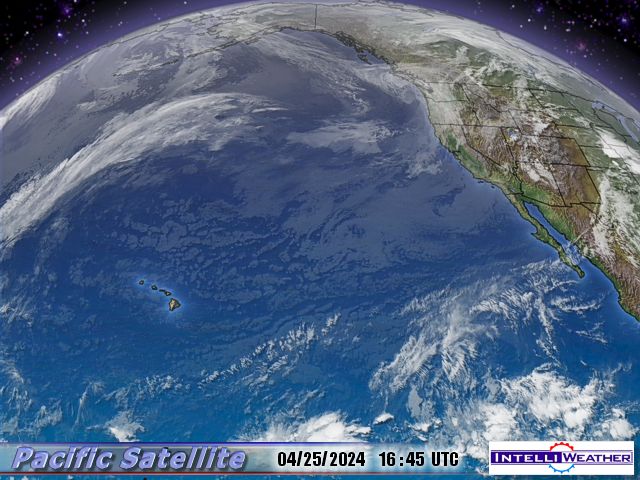
Here is the current Pacific satellite image, note the lower right.

Click for a larger image

I might add that the likelihood of a hurricane strength storm striking Southern California is low. Since 1900, only four tropical cyclones have brought gale-force winds to the Southwestern United States. They are an unnamed tropical storm that made landfall near San Pedro in 1939, the remnants of Hurricane Joanne in 1972, the remnants of Hurricane Kathleen in 1976, and Hurricane Nora in 1997 which entered California as a tropical storm.


The storms that do make it close enough to be a threat are often weakened by two facts: cold sea surface temperatures and upper level steering winds that tend to take them away for SoCal. But it’s a fun exercise to discuss the possibility. – Anthony


Hurricanes in Los Angeles?

Guest post by Roger Sowell

A hurricane hitting Los Angeles. No, it hasn’t happened yet, but it could. I am using the same reasoning as the Carbon Is Going to Kill Us crowd, where it is deemed prudent and even mandatory that we take action now to prevent a future catastrophe. AGW believers insist that all mankind (well, except for developing countries, of course!) curtail or stop altogether emitting carbon dioxide, as that may cause ice caps to melt and oceans to rise and population disruption.


There is a hurricane in the Pacific Ocean, headed directly toward Los Angeles. It’s name is Jimena (pronounced him -ay – nuh, accent on the ay). Jimema currently has winds of 135 miles per hour, and is just south of the tip of Baja, California. Its course is to the northwest, up the Baja peninsula.


Judging from the mass confusion a couple of years ago when Houston evacuated ahead of hurricane Rita, Los Angeles might want to start packing and driving today. Houston only had around 1 million people exiting the city, and had at least five freeways on which to do it. Los Angeles has approximately 3 million people, probably closer to 4 million, but the metropolitan area has 18 million, and only three ways out. There is the Interstate 10, going due East; Interstate 5 going North; and highway 101, also going north. I-5 also goes south, but little good that will do since one runs into San Diego and the hurricane.


A hurricane hitting Los Angeles. We must take prudent steps to avoid the certain disaster and destruction from a hurricane. We will not be required to wait 100 years for the results to be in. This hurricane will be here in less than 10 days. We must act today, while there is still time. The science is settled. Hurricanes hitting major population centers are a serious threat. Remember New Orleans and Hurricane Katrina. Houston and Hurricane Rita. We must mobilize FEMA so they can get their red tape all in order, ready to send trailers and water and food packs to Los Angeles.


The low-lying areas of Southern California are at risk of inundation from the storm surge. Ports and river basins will be swamped with seawater, causing un-told devastation to precious seashore that is a national treasure, as the California Coastal Commission regularly reminds us. A storm surge from a hurricane can be several feet. The California Coastal Commission was in a tizzy recently over the prospect of the ocean rising just one foot, in the next century. Where is the alarm, the hysterical and frantic activity, over a storm surge of 5 to 10 feet in the space of 24 hours?


Where is the clarion call to action from our state and city leaders? Governor Schwarzenegger, Mayor Villaraigosa, are you watching this hurricane? Have you prepared the state and city and county to deal with this?


Or, are you hoping the hurricane does arrive, and right away, so that the wildfires will finally be put out and the firefighters get some much-needed rest?
Stay tuned, sports fans. This is about to get interesting.

Tuesday, May 5, 2009

Tree-Killing Hurricanes Could Contribute To Global Warming


Using field measurements, satellite image analyses, and empirical models to evaluate forest and carbon cycle impacts, the researchers established that an average of 97 million trees have been affected each year for the past 150 years over the entire United States, resulting in a 53-million ton annual biomass loss and an average carbon release of 25 million tons. Forest impacts were primarily located in Gulf Coast areas, particularly southern Texas and Louisiana and south Florida, while significant impacts also occurred in eastern North Carolina.


A first-of-its kind, long-term study of hurricane impact on U.S. trees shows that hurricane damage can diminish a forest's ability to absorb carbon dioxide, a major contributor to global warming, from the atmosphere.

Tulane University researchers from the Department of Ecology and Evolutionary Biology examined the impact of tropical cyclones on U.S. forests from 1851-2000 and found that changes in hurricane frequency might contribute to global warming. The results will be published in an upcoming issue of the Proceedings of the National Academy of Sciences.


Trees absorb carbon dioxide as they grow, and release it when they die - either from old age or from trauma, such as hurricanes. The annual amount of carbon dioxide a forest removes from the atmosphere is determined by the ratio of tree growth to tree mortality each year.


When trees are destroyed en masse by hurricanes, not only will there be fewer trees in the forest to absorb greenhouse gases, but forests could eventually become emitters of carbon dioxide, warming the climate. And other studies, notes Tulane ecologist Jeff Chambers, indicate that hurricanes will intensify with a warming climate.


"If landfalling hurricanes become more intense or more frequent in the future, tree mortality and damage exceeding 50 million tons of tree biomass per year would result in a net carbon loss from U.S. forest ecosystems," says Chambers.


The study, which was led by Tulane postdoctoral research associate Hongcheng Zeng, establishes an important baseline to evaluate changes in the frequency and intensity of future landfalling hurricanes.


Using field measurements, satellite image analyses, and empirical models to evaluate forest and carbon cycle impacts, the researchers established that an average of 97 million trees have been affected each year for the past 150 years over the entire United States, resulting in a 53-million ton annual biomass loss and an average carbon release of 25 million tons. Forest impacts were primarily located in Gulf Coast areas, particularly southern Texas and Louisiana and south Florida, while significant impacts also occurred in eastern North Carolina.


Chambers compares the data from this study to a 2007 study that showed that a single storm - Hurricane Katrina - destroyed nearly 320 million trees with a total biomass loss equivalent to 50-140 percent of the net annual U.S. carbon sink in forest trees.


"The bottom line," says Chambers, "is that any sustained increase in hurricane tree biomass loss above 50 million tons would potentially undermine our efforts to reduce human fossil fuel carbon emissions."


Study contributors include Tulane lab researchers Robinson Negron-Juárez and David Baker; George Hurtt of the Institute for the Study of Earth, Oceans, and Space at the University of New Hampshire; and Mark Powell at the Hurricane Research Division, National Oceanic and Atmospheric Administration. For more information contact Tulane's Office of Public Relations.

Sunday, May 3, 2009

Al Gore, global warming and truth

I voted three times for Al Gore, twice for VP and once for President. I don't regret the first two votes...

The former Vice President spoke before the House Energy and Commerce Committee last week. It was not his shining hour. Some of what he said was hyperbole. Some of what he said is just not true. And he, or one of his staff, should surely have known the limits he was transgressing.

For example, when speaking about Arctic ice, he said this:
"New research, which draws upon recently declassified data collected by U.S. nuclear submarines traveling under the Arctic ice cap for the last 50 years ... has told us that the entire Arctic ice cap may totally disappear in summer in as little as five years."
What he might have added was that Arctic ice has only been measured for 30 years, and that it is recovering at the fastest rate ever recorded (from an extreme melt over the past 18 months) and it is more or less (within a standard deviation) back to normal now.

And what is it with Al Gore and 20 feet of sea level rise? He's used it before, it was debunked before, he said it was an honest mistake before--and here it is again:
"A recent study in the journal Science has now confirmed that the entire West Antarctic Ice Sheet is warming. Scientists have told us that if it were to collapse and slide into the sea, we would experience global sea level rise of another 20 feet worldwide."
What he didn't bother to tell the Committee was that the study was done by the same discredited scientist who produced the infamous hockey stick (and this study has the same methodological flaws), that the West Antarctic Ice Sheet has always been understood to be melting due to the absolutely normal warming that happens during interglacial periods, and that it consists of only 5% of Antarctica, while the other 95% is increasing ice cover by a staggering 100,000 square kilometers per decade. The IPCC predicts a sea level rise of about 0.6 meters this century. Same as last century.

And in a staggering bit of true hypocrisy, Al Gore tries to tie a drought in the Southeast to climate change:
"The American West and the Southeast have been experiencing prolonged severe drought and historic water shortages. A study ... from the Scripps Institute estimated that 60 percent of the changes in the West's water cycle are due to increased atmospheric man-made greenhouse gases."
But what he fails to add is that temperatures in the Southeast have been falling--for 112 years at a rate of 0.12 degrees per decade. And he also fails to mention that drought in the West has been much worse and much worse more frequently in the past, before we began emitting those pesky greenhouse gases.

The statement that takes the cake, however, is this one:
"A number of new studies continue to show that climate change is increasing the intensity of hurricanes. Although we cannot attribute any particular storm to global warming, we can certainly look at the trend. Dr. Greg Holland from the National Center for Atmospheric Research says that we have experienced a 300 to 400 percent increase in category five storms in the past 10 years."
And this is the limit. Every study done in the past 2 years has shown that the energy frequency of hurricanes and tropical storms has fallen to an all time low, causing some respected proponents of the theory to change their minds in a hurry. Every study. There's no excuse for this, Mr. Vice President. At some point, we will have to use the 'L' word.

sponsored links


Dewa Project Dewa Project Dewa Project